20 Most Frequently Asked Questions About Balloon Mollies (Beginner’s Guide)
New to balloon mollies? Here are quick, straight answers to the questions beginners ask most. Each one’s short on purpose — longer deep-dive articles on the trickier topics are linked as they go live.
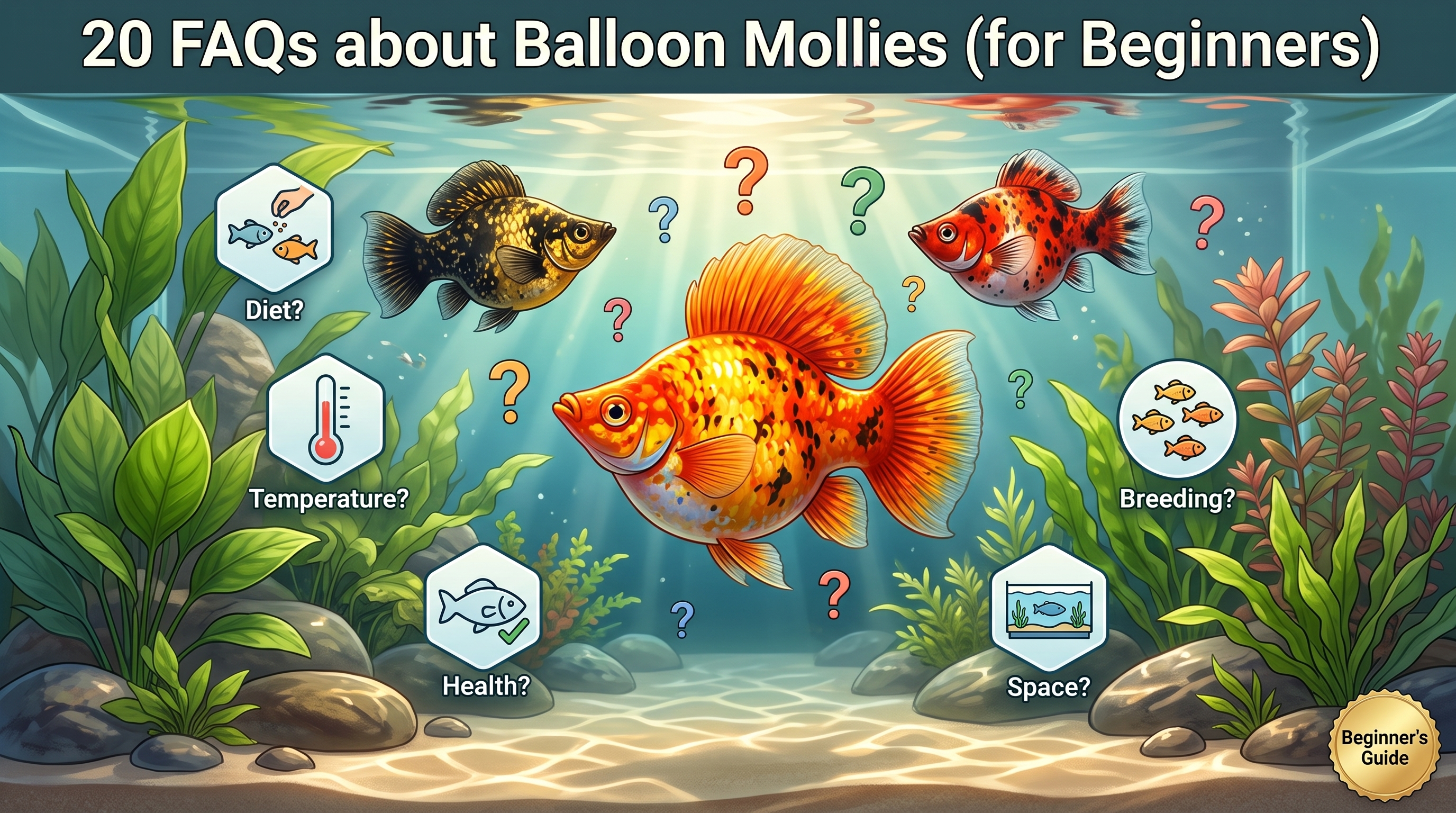
1. What exactly is a balloon molly?
A balloon molly is a selectively bred variant of the common molly (Poecilia sphenops) with a shortened, curved spine that gives it a rounded, “balloon-like” body shape. It’s not a separate species — it’s a deliberately bred deformity that’s been popular in the aquarium trade for decades.
2. Is the round body a birth defect?
Yes, technically. The rounded shape comes from a spinal curvature (scoliosis-like deformity) that breeders have selected for and stabilized over generations. It’s controversial in the hobby precisely because it’s a skeletal deformity being bred on purpose for appearance.
3. Are balloon mollies good for beginners?
Generally yes — they’re hardy, tolerant of a range of water conditions, and forgiving of beginner mistakes compared to many other freshwater fish. Their main beginner risk isn’t difficulty, it’s tank size and water quality neglect, since mollies are heavier waste producers than their size suggests.
4. What size tank do balloon mollies need?
A single balloon molly needs at least 10 liters of water if you do 20-30% water changes twice a week with sponge filtration, but because they’re social and do best in groups, a 30 liter tank is a much more realistic starting point for a trio. Bigger tanks also dilute waste faster, which matters since mollies are sensitive to poor water quality despite their reputation for hardiness.
5. What water temperature do balloon mollies need?
Balloon mollies do best between 24–28°C, though they can tolerate warmer conditions in tropical climates. Stability matters more than the exact number — sudden temperature swings stress them out far more than a slightly warm or cool tank.
6. Do balloon mollies need freshwater or saltwater?
Freshwater, but with a twist — mollies are naturally found in brackish (part-salt) environments in the wild and often thrive with a small amount of aquarium salt added. Full marine saltwater is not necessary or recommended for a standard home setup.
7. What do balloon mollies eat?
A quality flake or pellet food formulated for livebearers or omnivores works as a staple diet. Mollies also benefit from regular vegetable matter (blanched zucchini, spirulina-based foods) since they graze on algae and plant matter in the wild.
8. How long do balloon mollies live?
With good care, balloon mollies typically live around 1 to 1.5 years. Their lifespan is often shorter than standard mollies due to the spinal deformity affecting internal organ function and swimming efficiency.
9. What fish make good tank mates for balloon mollies?
Peaceful community fish that share similar water parameters work well — think platies, guppies, tetras, and corydoras. Avoid notorious fin-nippers, since a balloon molly’s rounded body and slower swimming make it an easy target.
10. How can I tell a male from a female balloon molly?
Males have a modified anal fin called a gonopodium, which looks like a narrow, pointed rod instead of a fan-shaped fin. Females have the standard fan-shaped anal fin and are typically larger and rounder-bodied overall.
11. Do balloon mollies give birth to live babies?
Yes — mollies are livebearers, meaning females give birth to free-swimming fry rather than laying eggs. There’s no egg stage to manage at all; the fry are ready to swim and eat immediately after birth.
12. How often do balloon mollies breed?
A healthy, mature female can give birth roughly every 4–6 weeks. Females can also store sperm from a single mating and use it for multiple pregnancies, so fry can appear even without a male currently in the tank.
13. How many fry does a balloon molly have per batch?
Litter sizes vary widely, anywhere from a handful up to 40-plus fry, depending on the female’s size, age, and health. Larger, more mature females generally produce bigger litters.
14. Will balloon mollies eat their own babies?
Yes, unfortunately — mollies (like most livebearers) will readily eat their own fry if given the chance. If you want to raise the babies, you’ll need a breeding box, a heavily planted tank for fry to hide in, or a separate nursery tank.
15. Do balloon mollies need a heater and filter?
In Singapore, a heater isn’t necessary. Outside of Southeast-Asia where temperatures are colder during winters, heater is needed to keep temperatures stable, and a filter is essential since mollies produce more waste than their size suggests. Gentle filtration (such as sponge filters) is best — balloon mollies aren’t strong swimmers and can struggle against a strong current.
16. Why is my balloon molly swimming oddly or struggling to stay upright?
Balloon mollies are prone to swim bladder issues because their compressed, curved spine puts pressure on internal organs, including the swim bladder. Some awkward swimming is unfortunately normal for the breed, but sudden changes are worth investigating as a possible health issue.
17. What colors do balloon mollies come in?
Common colors include orange/gold, black, dalmatian (black-and-white spotted), silver, and various mixed patterns. Fin types also vary — you’ll see both standard and “lyretail” (long, flowing tail) balloon mollies.
18. Are balloon mollies aggressive?
No, they’re generally peaceful fish and don’t bother tank mates. The bigger risk usually runs the other way — their slower, less agile swimming makes them more vulnerable to boisterous or nippy tank mates rather than the other way around.
19. Why do some people say balloon mollies are unethical to breed?
The core objection is that the “balloon” shape is a selectively bred skeletal deformity that can compress internal organs, shorten lifespan, and impair swimming — traits bred for looks rather than fish welfare. It’s a genuinely debated topic in the hobby, and reasonable, experienced keepers land on different sides of it.
20. Should I mix balloon mollies with standard (non-balloon) mollies?
You can, and many keepers do — they’re the same species and will happily interact and even interbreed. Just know that breeding a balloon molly with a standard molly produces mixed results, since the balloon shape isn’t a simple one-gene trait that passes on predictably.
Got a beginner question that’s not on this list? Send it in — future deep-dive articles will link back here as they go live.
Any questions? Join our telegram group http://t.me/singaporefish to ask our group experts.
Join our telegram channel for more molly stories, farm visits and news