Muppies and Gollies: The Real Story Behind Guppy × Molly Crosses
Every fishkeeping forum has that one thread. Someone posts a photo of a weird-looking fry and says “I think my guppy and molly had babies!”
The comments explode. Half the room says “impossible,” the other half swears they’ve been breeding these things for years and calls them muppies (molly + guppy) or gollies.
Turns out, both sides are a little right. This isn’t a clean myth like “goldfish only have a 3-second memory.” It’s messier, weirder, and honestly more interesting than a flat yes-or-no.
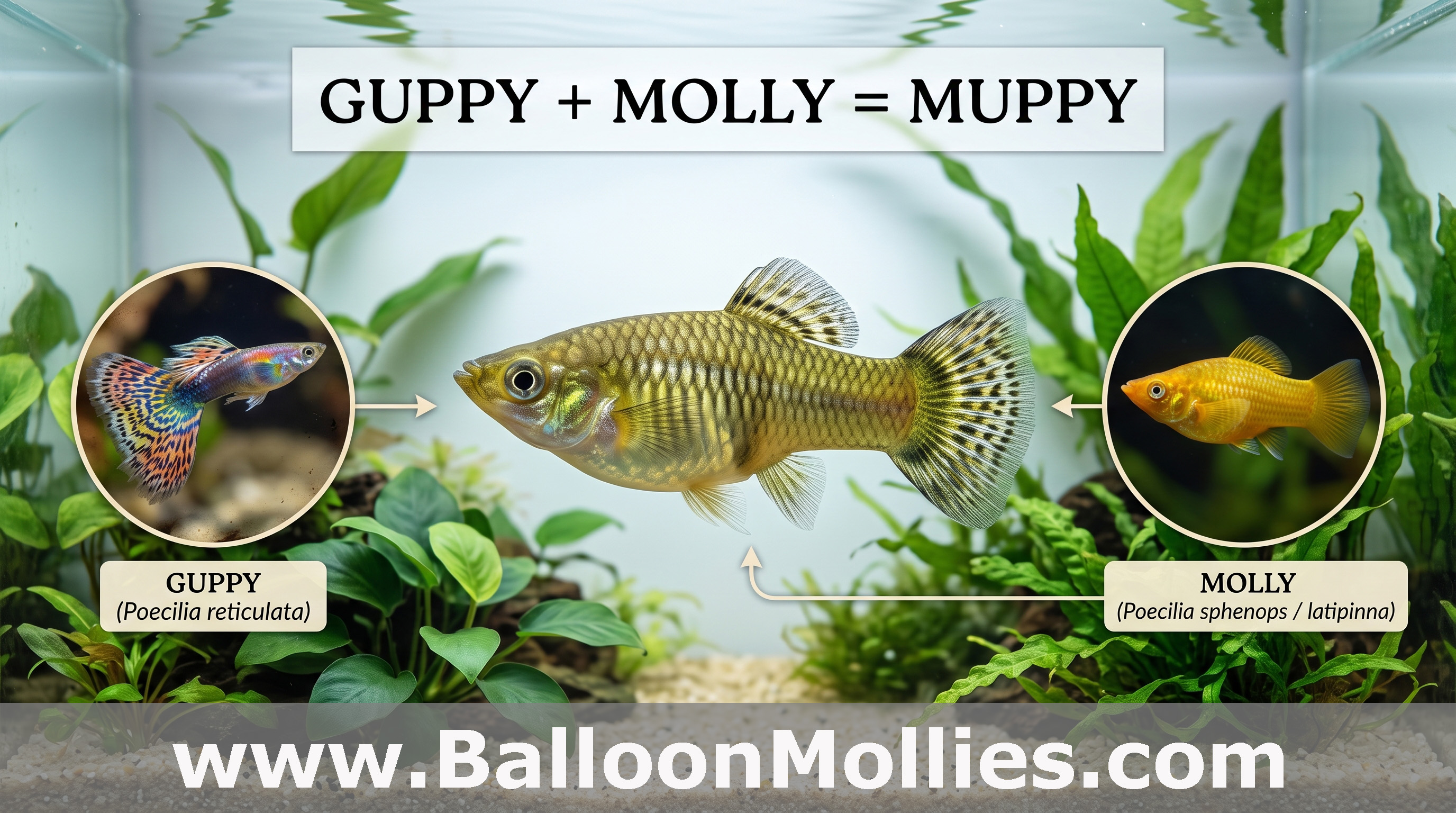
Wait, Muppies Are Actually a Thing?
Yes — sort of. Hobbyists have been documenting guppy × molly crosses since at least the late 2000s. Long-running threads on forums like PlantedTank, MonsterFishKeepers, and TropicalFishKeeping show real fry with mixed traits: guppy-shaped heads on molly-shaped bodies, guppy fin colors and patterns on a heavier molly frame, or an intermediate body shape that doesn’t cleanly match either parent species (PlantedTank thread; TropicalFishKeeping thread).
One dedicated breeder documented an entire “Muppy Project” with photos of F1 offspring showing a wide range of colors and patterns depending on which molly and guppy varieties were crossed, and later claimed to have pushed the line further by backcrossing into a fertile F2 generation (AquariaCentral Muppy Project; emeraldking-aquatics writeup).
The Direction Matters
Almost everyone agrees on one detail: the cross that occasionally works is male molly × female guppy — not the reverse. The logic is straightforward:
- Mollies give birth to noticeably larger fry than guppies.
- A female guppy carrying molly-sized babies is a serious size mismatch that can injure or kill her during birth.
- So even in successful cases, breeders deliberately pair a male molly with a female guppy, never the other way around.
Why It Sometimes “Works” at All
Guppies (Poecilia reticulata) and mollies (Poecilia sphenops, P. latipinna, P. velifera) are in the same genus, unlike, say, guppies and platies (Xiphophorus), which are in different genera and don’t cross. Same-genus status is exactly why occasional viable hybrids are biologically plausible here in a way they aren’t for guppy × platy claims.
Why It Mostly Doesn’t Go Anywhere
Even when a cross “takes,” the consensus across years of hobbyist attempts is grim for anyone hoping to build a breeding line:
-
Sterility is the norm. Most muppies/gollies are reported as sterile — they can’t reproduce with a guppy, a molly, or even another muppy. One long-time breeder estimated roughly 99% of offspring turn out sterile even under deliberate breeding attempts.
-
Health issues are common. Multiple hobbyists note that “a healthy muppy is hard to find,” with genetic defects and shortened lifespans frequently reported.
-
Even motivated breeders often get nothing. One hobbyist raised a male muppy specifically to test if it would breed, watching closely — it never attempted to mate with anything.
The Skeptic’s Case: A Lot of “Muppy” Photos Aren’t Muppies
Here’s the part that validates the doubters too. A huge share of “surprise hybrid fry” posts have a much simpler explanation:
-
Stored sperm. Female guppies (and mollies) can store viable sperm for months. A “virgin” female bought from a shop may already be carrying sperm from an earlier mate, so fry showing up with no male in sight — or looking “off” from mom — is usually just a delayed, ordinary pregnancy, not a cross.
-
Normal genetic variation. Guppy color genetics are wildly variable on their own; an odd-colored fry is often just… genetics being genetics.
-
Outright fakes. Hobbyists searching for muppy photos have specifically flagged some circulating images as suspected or confirmed fraud.
So when someone shows you a “muppy” photo, the honest response is: maybe — but check whether the female could’ve been previously mated, and treat single unverified photos with healthy suspicion.
Quick Reference: Why / Why Not
| Question | Verdict |
|---|---|
| Can male molly × female guppy occasionally produce fry? | Yes — documented repeatedly over 15+ years of hobbyist breeding |
| Can female guppy × male molly work the same way? | Not recommended — size mismatch risks killing the female |
| Are the offspring usually fertile? | No — sterility is the norm; fertile F2 claims exist but aren’t independently verified |
| Are all “muppy” photos real? | No — many are stored-sperm surprises, misidentified variation, or fakes |
| Is this good practice for serious breeders? | Generally not — see below |
Why This Matters for Serious Breeders
If you’re running selective lines — say, a tancho balloon molly project chasing a clean white body with a red head patch — muppies are a curiosity, not a strategy. Even in the best documented cases, you’re looking at low success rates, sterile or unhealthy offspring, and zero ability to lock in a trait for future generations. Cleaner path: keep your species-pure lines separate, and do your deliberate crossing within the species (redhead × sakura, etc.), where genetics can actually give you something repeatable.
The Bottom Line
Muppies and gollies are real enough to have a 15+ year hobbyist paper trail, real enough that dedicated breeders have documented multi-generation attempts — and rare and unreliable enough that most of what circulates online is either a dead-end sterile novelty or not a hybrid at all. If you want one for fun, go in with eyes open. If you want a breeding program, stick to intraspecies work.
Any questions? Join our telegram group http://t.me/singaporefish to ask our group experts.
Join our telegram channel for more molly stories, farm visits and news
Sources:
- AquariaCentral — Muppy Project
- emeraldking-aquatics — Interesting Offspring
- PlantedTank — Molly x Guppy Babies
- PlantedTank — Has anyone made Muppies?
- TropicalFishKeeping — What is a Muppy?
- MonsterFishKeepers — Molly and Guppy Hybrids
- Fishlore — Guppy/Mollie Crossbreeding
Filed under fishkeeping folklore that’s actually got some truth to it.