Judge Balloon Mollies - How Champions are picked
Picture a molly show. Rows of little tanks, each one holding a fish that someone has spent months (sometimes years) breeding for exactly the right shape, exactly the right hump on the back, exactly the right pop of color. Then a judge walks by, looks at your fish for maybe a minute, and writes down scores that decides whether it goes home a champion or just… a very nice pet.

A minute doesn’t sound like much. But behind that glance is a whole system — one I’m learning firsthand, because I’ll be apprenticing under Chief Judge Arinday at MFBAN’s (Molly Fish Breeders Association of Negros) fellowship in December 2026, right when they’re dropping a rulebook the size of a phone book (400+ pages, 80+ chapters, apparently).
Until then, here’s the simplified version — the stuff I’m using to make sure I don’t embarrass myself on day one.
The Judging Assembly Line
Every fish that gets “benched in” (fancy term for “entered into the show”) goes through the same eleven-step gauntlet:
- Fish Entry – welcome to the show, little guy.
- Health Inspection – are you actually healthy and not obviously sick?
- Class Verification – are you even in the right category?
- Body Conformation – do you look the way a balloon molly is supposed to look?
- Color Assessment – are your colors doing their job?
- Fin Structure – how are those fins holding up?
- Deportment – are you swimming around like you own the place, or hiding in the corner sulking?
- Condition – overall, are you thriving or just surviving?
- Score Tabulation – add it all up.
- Pro-Rata Adjustment – a fairness tweak so nobody gets robbed by a harsh judge or an easy one.
- Class Ranking – and the winner is…
Most of the actual judging drama happens in steps 4 through 8. But before we get into what can go wrong, let’s talk about what the judge is actually looking for — because it’s not what most people assume.
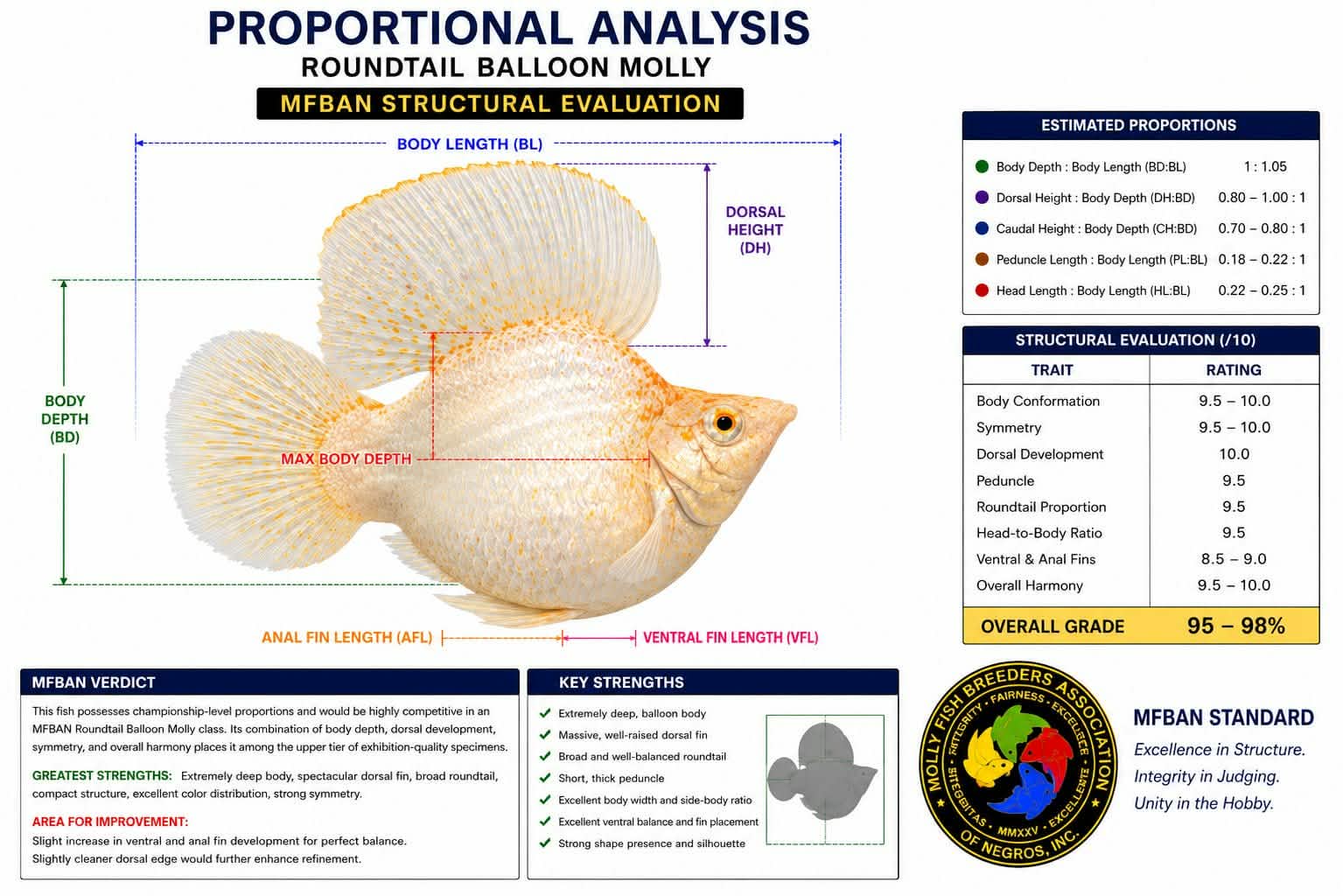
Shape Is the Whole Ballgame
Here’s the thing casual observers get wrong about molly shows: they assume it’s mostly about color. Big, bright, eye-catching color. Nope. Color is the garnish. The main course is shape — and it’s not close.
MFBAN splits the scoresheet into three parts:
| Category | Weight | What’s in it |
|---|---|---|
| 🏋️ Body | 50% | Conformation (30%) + Size (10%) + Symmetry (5%) + Finnage (5%) |
| ❤️ Overall Health | 30% | Deportment/Harmony (15%) + Vitality (15%) |
| 🎨 Color | 20% | Vibrancy (10%) + Intensity (10%) |
Read that again: Body is half the score, all by itself.
Not “body and color together.” Just body.
A balloon molly could be flawlessly, dazzlingly colored and still lose to a fish with mediocre color but a textbook-perfect shape — because shape is worth two and a half times as much as color on the sheet.
Why does the rulebook lean this hard on shape?
Because “balloon molly” isn’t a color, it’s a body type.
The whole point of the variety is that characteristic hump on the back and the round, forward-lunging belly — that silhouette is the breed.
A balloon molly with a flat back or an elongated body isn’t a balloon molly with a fault; per the standard, it’s not a balloon molly at all, and gets disqualified outright regardless of how it’s colored.
Shape isn’t one ingredient in the recipe — it’s the recipe.
So what is a judge actually squinting at when they evaluate “Body”?
- Conformation (30% — the single biggest line item on the entire sheet): Does the fish have that signature curve on the back and the big, round, bulging belly? Is the head-to-trunk-to-tail balance right? This is the fish’s whole identity as a balloon molly.
- Size (10%): Is it within the expected adult range (roughly 2.5–3 inches), not a runt and not something disproportionate?
- Symmetry (5%): Does the left side match the right side? Nothing lopsided or twisted?
- Finnage (5%): Are all fins present, proportional, and in balance with the rest of the body?
Health and color matter too, obviously — a fish that’s listless or faded isn’t winning anything — but they’re supporting actors. Shape is the lead.
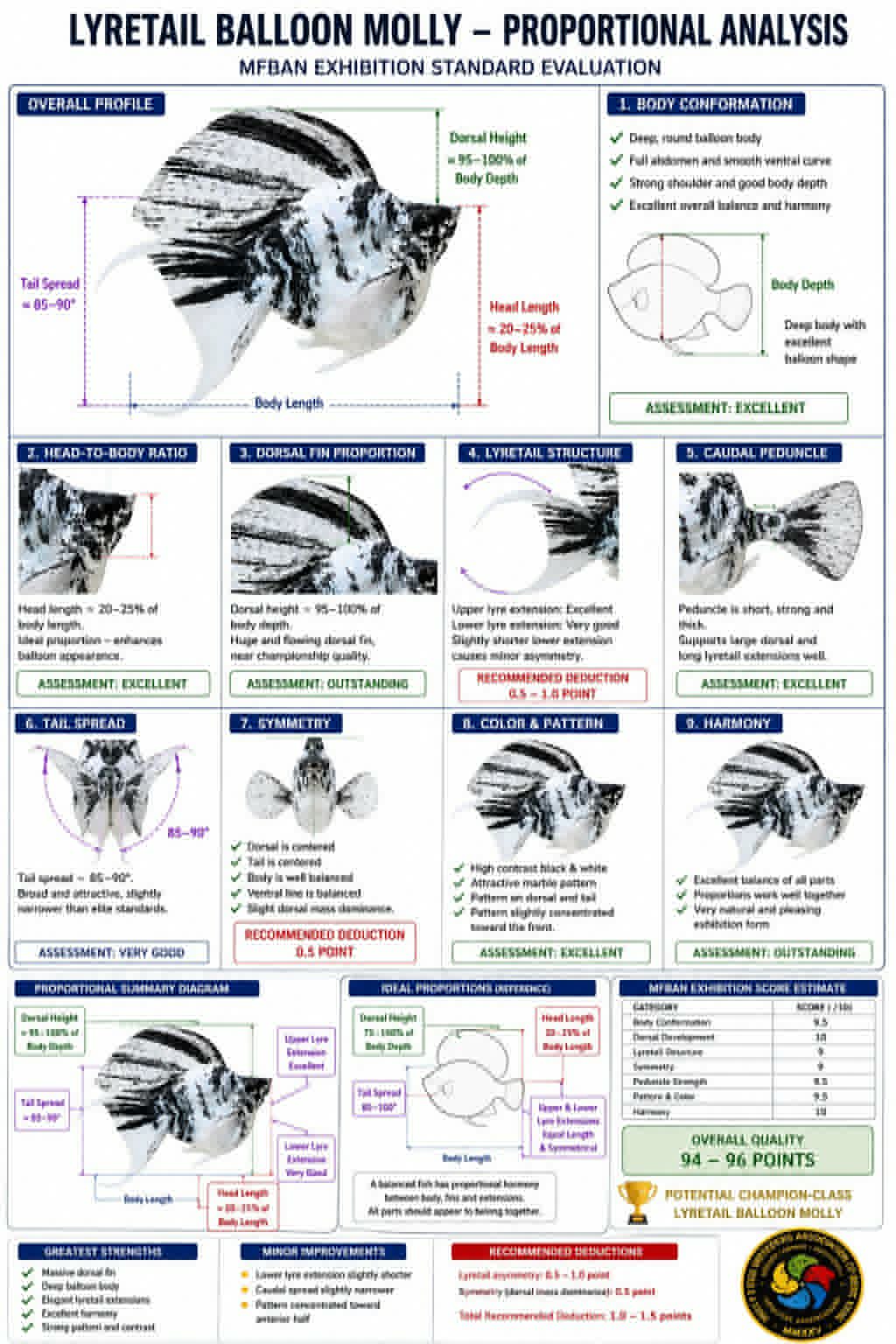
Two Questions, Not One
Here’s the thing that trips up rookie judges (allegedly — I haven’t tripped yet, ask me in December): people think “finding a fault” is one step. It’s actually two, and they’re very different questions:
- “What’s wrong with this fish?” — that’s the kind of fault.
- “How much do I actually care?” — that’s the classification.
A missing scale and a crooked spine are both “faults,” but nobody’s losing sleep over the missing scale. Treating them the same would be like giving a parking ticket and a felony charge the same fine. MFBAN’s whole system exists so judges don’t do that.
And true to everything above: notice how many of the “big deal” faults below are shape faults. That’s not a coincidence — it’s the scoresheet’s 50% weighting showing up again at the fault level.
The Six Ways a Fish Can Go Wrong
Think of these as the “departments” where problems show up:
🦴 Structural — the skeleton and body shape department. Crooked spine, long peduncle (skinny tail-stalk), humpback, lopsided body, weird head shape.
🎏 Finnage — the fins department. Split dorsal, folded tail, missing rays, a lyretail where one side is longer than the other, fins clamped shut like they’re cold.
🎨 Color — the paint job department. Faded patches, blotchy distribution, colors bleeding into each other, general “dirty” muddiness.
🐟 Scales — the armor department. Missing scales, lifted scales (like shingles popping off a roof), patchy uneven scaling.
👁️ Eyes — the windows-to-the-soul department. Bulging eyes, “armored” (overgrown) eyes, a blind eye, or eyes that don’t match each other.
❤️ Condition & Health — the “are you actually okay” department. Skinny/emaciated, visible disease, lethargic (basically fish depression), fin rot.
Okay, But How Bad Is Bad?
This is the part that actually decides the score. Once you know what is wrong, you decide how much it matters, on a four-level scale:
| Level | What it looks like | What it costs |
|---|---|---|
| 🟢 Minor | Barely-there stuff. A slightly wonky dorsal tilt, one tiny missing scale, color that’s just a shade off. | 1–3 points — basically a shrug |
| 🟡 Moderate | You’d notice it if you were looking, and it does knock the fish down a peg. Noticeably long peduncle, visible fin asymmetry, patchy color. | 4–10 points — a real dent |
| 🔴 Major | Hard to ignore. Crooked spine, badly folded fins, a missing lyretail point, a body that looks visibly off-balance. | 11–25 points — ouch |
| ⛔ Disqualifying | Game over. Dead fish, serious disease, obvious tampering (yes, people try), missing body parts, gross deformity. | Zero. You’re out. |
The fun (annoying?) part: the same fault can land anywhere on this scale depending on how bad it is. A “long peduncle” might just be a minor ding — or it might be so extreme it tips into major territory. Judging isn’t a lookup table, it’s a lookup table plus judgment. Hence, you know, the word “judge.”
Quick Cheat Sheet
| Fault | Department | Could Be Rated |
|---|---|---|
| Missing scale | Scales | Minor or Moderate |
| Long peduncle | Structural | Moderate or Major |
| Bulging eye | Eyes | Minor, Moderate, or Major (depends how bad) |
| Fin rot | Health/Fins | Major or Disqualifying |
| Crooked spine | Structural | Major or Disqualifying |
| Uneven color | Color | Minor or Moderate |
The One-Sentence Version
If you remember nothing else, remember it in this order: shape first, then health, then color — and when something’s wrong, name it before you decide how much it matters. A fish wins or loses on its silhouette long before anyone’s arguing about hue. Faults are just where that silhouette (or the health and color behind it) breaks down.
I’ll be putting this to the test in December, standing next to Chief Judge Arinday trying not to visibly panic while staring at somebody’s prize-winning sakura molly. Once the full 400-page rulebook lands, expect this page to get a lot longer (and hopefully I’ll have made all my rookie mistakes by then instead of on show day).
Reference: MFBAN (Molly Fish Breeders Association of Negros) judging framework. Full rulebook forthcoming, December 2026.